
New2 min read
Ascott: new ultra compact corrosion test chambers
Ascott has introduced a new generation of compact front-loading chambers for salt spray and cyclic corrosion testing, in 300 and 400 litre capacities.
Read more
Classic salt spray testing and cyclic corrosion testing differ in the conditions the sample is exposed to. Ascott explains the difference.

Salt spray testing and cyclic corrosion testing are the two most widely used methods for assessing corrosion resistance. They are often confused, yet they answer different questions. This is a summary of the explanation by Ascott Analytical.
Specimens are continuously exposed to a corrosive salt fog. A saline solution is atomised into a consistent fog, and after a set exposure period the specimens are inspected for corrosion, coating failure and other changes. The most widely used standards are ASTM B117 and ISO 9227, familiar in automotive, aerospace, coatings, metal finishing and general manufacturing.
The test is highly repeatable and internationally recognised, so it is used for comparing coatings, quality control, process verification, supplier approval and meeting customer specifications.
In cyclic testing, specimens move through a sequence of changing conditions instead of a constant fog. An example sequence: salt spray, high humidity, drying, temperature control, refrigeration, then repeat. Cycles can also include condensation humidity or controlled relative humidity, and run automatically for hours or days.
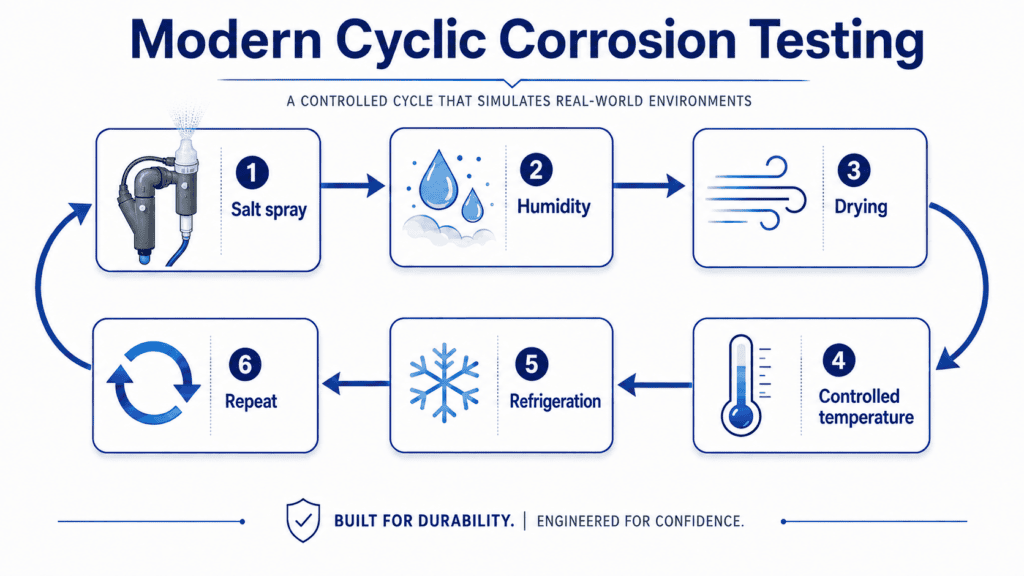
In practice, corrosion rarely happens under a single constant condition. Vehicles, marine parts and industrial components alternate between salt contamination, wetness, drying and temperature change. Cyclic testing tries to reproduce some of this in a controlled laboratory programme and can reveal corrosion mechanisms that do not appear in the same way under constant fog.
It is important, however, that cyclic testing does not automatically replace salt spray. The correct method is set by the relevant standard, the customer specification or the validation programme.
- Salt spray: continuous salt fog, a constant and aggressive condition, highly repeatable, typically used for comparison, quality control and approvals.
- Cyclic corrosion: a sequence of different stages, closer to real-world conditions, repeatability depends on the specific standard, typically used for more complex multi-climate validation.
- automotive, which increasingly specifies cyclic standards combining salt, humidity, drying and temperature,
- aerospace and defence, where parts face temperature extremes, moisture and saline contamination,
- coatings and paints, to compare formulations and protective performance,
- marine equipment, with repeated wetting, salt deposition and drying,
- electronics, for enclosures and connectors.

Test hours cannot be converted directly into years of service: 1,000 hours of salt spray does not equal a fixed number of years in use. Results depend on the material, coating type and thickness, geometry, temperature, humidity, salt concentration, wet and dry periods and the real operating environment. Accelerated testing is best used as a comparative and validation tool when a defined method is followed.
If the specification calls for neutral salt spray to ASTM B117 or ISO 9227, the chamber must deliver those conditions accurately and repeatably. If the requirement includes programmed humidity, drying, changing temperature or refrigeration, you need a cyclic chamber. A laboratory buying equipment only for today's tests may later need more advanced customer-specific tests, so future needs are worth considering.
Before purchasing, define: required standards, specimen size and number, chamber capacity, temperature range, humidity, drying, refrigeration and planned test programmes. We will gladly advise you and prepare a quotation for Ascott chambers.
Source: https://www.ascott-analytical.com/salt-spray-vs-cyclic-corrosion-testing-whats-the-difference/
Ascott has introduced a new generation of compact front-loading chambers for salt spray and cyclic corrosion testing, in 300 and 400 litre capacities.
Read moreJULABO has introduced the VALEGRO 250, a compact entry-level recirculating chiller that replaces the F250.
Read moreWrite to us or give us a call. We'll be happy to advise you.
